In the grand narrative of green technology, we often focus on the titans: the massive wind turbines offshore, the sprawling solar farms in the desert, and the heavy lithium-ion packs driving electric vehicles. But a quiet revolution is brewing on the opposite end of the spectrum—the microscopic scale.
For decades, the “Internet of Things” (IoT) and the proliferation of smart sensors have been shackled by a single, stubborn limitation: the battery. Every sensor placed on a bridge to monitor structural integrity, or in a forest to detect wildfires, eventually dies, requiring a complex and wasteful replacement cycle.
Now, a breakthrough from the Hamburg University of Technology (TUHH), in collaboration with researchers across Europe, promises to sever this tether. By leveraging the physics of water flow friction at the nanoscale, these scientists have unlocked a method to generate electricity directly from the movement of fluids. It is a discovery that doesn’t just improve batteries; it threatens to render them obsolete for a vast array of devices.
The Science of “Blue Energy”
To understand this innovation, we must look beyond the traditional hydroelectric dam. Conventional hydropower relies on gravity—massive amounts of water falling through a turbine. The new research, however, relies on electro-kinetics and the interactions between water and solid surfaces at the molecular level.
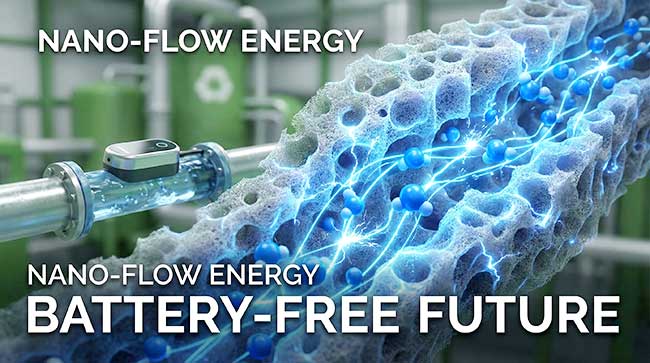
The concept utilizes a phenomenon known as the “streaming potential.” When an electrolyte fluid (like salt water or tap water) is forced through a very narrow channel, the friction against the channel walls creates a separation of electric charge.
Historically, this process was inefficient. The energy generated was negligible, nothing more than a laboratory curiosity. The breakthrough achieved by the German-led team lies in the material structure. Rather than using a single channel, they have engineered a specialized aerogel—a highly porous material that acts like a stiff, ultra-light sponge.
Here is how it works:
- The Structure: The material is riddled with billions of tiny pores at the nanoscale.
- The Flow: When water penetrates these pores, it is subjected to pressure.
- The Friction: As the water is forced through these nanoscopic tunnels, the friction strips electrons, creating a flow of ions.
- The Harvest: Because of the massive surface area inside the aerogel, this friction is multiplied exponentially, converting the mechanical pressure of the water directly into usable electrical energy.
The researchers described this as “the beginning of a new generation” of power generation. By fine-tuning the geometry of the pores and the surface chemistry of the material, they have turned the flow of water into a highly efficient electron pump.
The Battery Problem
To appreciate the magnitude of this discovery, one must look at the “hidden crisis” of green tech: electronic waste.
The world is currently deploying billions of micro-sensors to make our cities “smart” and our industries efficient. If we deploy one trillion sensors by 2030 (a realistic forecast), and each runs on a coin-cell battery with a three-year lifespan, we are looking at discarding roughly 900 million batteries every single day.
Lithium extraction is environmentally taxing, and battery disposal creates toxic hazards. Furthermore, the logistical cost of sending a technician to a remote location just to swap a battery often exceeds the cost of the device itself.
This new hydrovoltaic technology offers a “install and forget” solution. As long as there is fluid movement—whether it is rain running down a roof, wastewater moving through a pipe, or even blood flowing through a vein—there is power.
Applications: A World Without Wires
The implications of this technology extend far beyond simple waterproofing. By eliminating the bulk and chemical volatility of batteries, engineers can redesign devices entirely.
- Smart Water Management The most immediate application is in water infrastructure. Utility companies lose billions of gallons annually to leaks in aging pipe networks. Self-powered sensors, energized by the very water flowing through the pipes, could monitor pressure and quality in real-time, pinpointing leaks the moment they occur without ever needing maintenance.
- Environmental Monitoring Imagine biodegradable sensors dispersed in a rainforest to track humidity and temperature. Powered by the friction of rainwater seeping through them, these devices could operate indefinitely, transmitting data to satellites to help predict climate patterns or alert authorities to illegal logging, leaving no toxic chemical residue behind.
- Biomedical Implants Perhaps the most futuristic application is within the human body. Our bodies are hydraulic systems; blood flows under pressure continuously. Nanoscale generators could theoretically power pacemakers or glucose monitors using the friction of blood flow, eliminating the risky surgeries currently required to replace the batteries in these life-saving devices.
The Efficiency Leap
What makes the work from the Hamburg University of Technology stand out is the efficiency conversion. In the past, forcing water through nanopores required immense pressure that consumed more energy than it produced.
The new porous materials allow for a phenomenon called surface conductivity. Because the surface area is so vast relative to the volume of water, the “friction” generates a surface current that is surprisingly potent. The researchers have demonstrated that this method can power LEDs and electronic paper displays, moving firmly out of the realm of theory and into application.
“This is not about powering a city, but about empowering the intelligence of the city.”
It is important to manage expectations: this technology will not power your electric car or run your home air conditioner. Those applications require high-energy density storage. This breakthrough is aimed at the micro-watt to milli-watt range—the domain of the microprocessor and the sensor.
The Road Ahead
While the laboratory results are “electrifying,” scaling this technology presents challenges. Manufacturing nanomaterials with precise pore structures at an industrial scale is complex and historically expensive. The researchers must now focus on durability: how long can these aerogels withstand the constant erosion of water flow before their structure degrades?
However, the raw materials involved—often silicon or carbon-based—are abundant and non-toxic, offering a stark advantage over the cobalt and nickel required for batteries.
Conclusion: The Flow of the Future
We are witnessing a paradigm shift in how we view energy. For a century, we have treated energy as something we must hunt, capture, and store in chemical prisons (batteries).
The breakthrough in Hamburg suggests a different future: one where energy is harvested from the ambient environment. By tapping into the kinetic energy of water at the nanoscale, we are moving toward a world of self-sufficient technology. It is a future where our devices are lighter, cleaner, and longer-lasting—powered not by a limited chemical reaction, but by the eternal flow of nature itself.
The battery may not disappear overnight, but its stranglehold on our technology is finally loosening.
Citation
https://intranet.tuhh.de/presse/pressemitteilung_einzeln.php?id=14906